
Beyond Automation: AI Agents as Trusted Knowledge Collaborators
At trustassist ai, we’re reshaping how BMETs tackle repairs and diagnostics, making medical device upkeep smarter, faster, and more reliable.
5/8/20242 min read
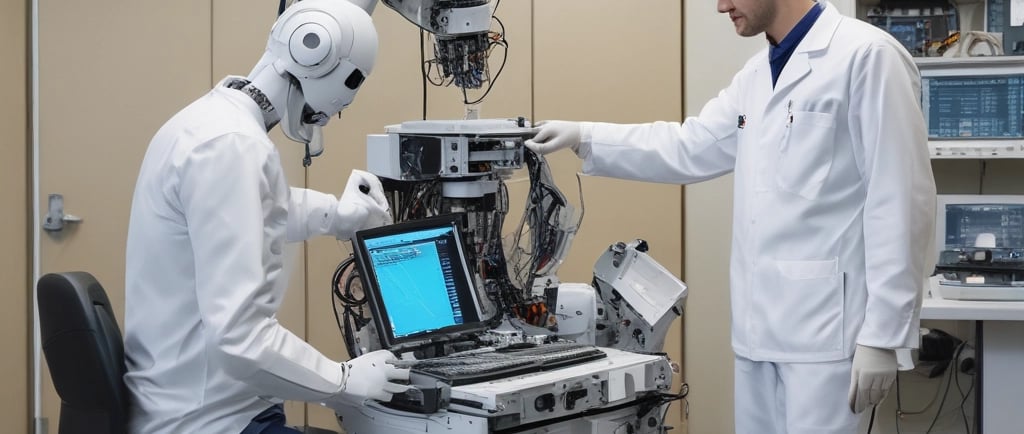
In the age of digital transformation, automation has evolved beyond simple task completion to become an integral part of modern workplaces. But what lies beyond automation? The answer: AI agents as trusted knowledge collaborators. These AI agents are not just performing tasks; they are reshaping the very nature of how knowledge work is conducted, leading to unprecedented productivity and innovation.
What Are AI Knowledge Collaborators?
Unlike traditional automation systems, AI knowledge collaborators are designed to assist with cognitive tasks that require analysis, learning, and adaptation. They integrate into workflows not just as tools, but as digital co-workers capable of interacting with data, making recommendations, and learning from outcomes. These agents operate with advanced capabilities such as natural language processing (NLP), machine learning (ML), and contextual awareness, enabling them to handle complex information and support decision-making processes.
The Shift from Automation to Collaboration
Historically, automation focused on streamlining repetitive and rule-based tasks. This limited its application primarily to manual or operational processes. However, AI agents as knowledge collaborators push this boundary. They process massive amounts of data, discern patterns, and generate insights that a human alone would find time-consuming or difficult to achieve. For example, consider how these agents can compile, filter, and present relevant information to aid in strategy development or client pitches—tasks that demand higher-level cognitive engagement.
This shift transforms the role of AI from an execution tool to a partner in problem-solving and innovation. These agents bridge gaps in knowledge management, supporting professionals in a wide range of industries, from finance to healthcare, by providing real-time data analysis and scenario planning.
Key Benefits of AI Knowledge Collaborators
1. Enhanced Decision-Making: AI knowledge collaborators analyze data sets at speeds unmatched by human workers. By presenting synthesized insights, they enable knowledge workers to make faster, data-backed decisions. For instance, a marketing manager using an AI assistant can quickly access consumer trend analyses to refine campaign strategies.
2. Augmented Productivity: With AI agents handling routine yet cognitively demanding tasks—such as sorting through research data or preparing comprehensive reports—knowledge workers can redirect their focus to more creative or strategic projects, thus boosting overall productivity.
3. Continuous Learning and Adaptation: Modern AI agents learn from each interaction, adapting their recommendations and processes. This means they improve over time, becoming more aligned with the unique needs of the professionals they assist.
4. Collaboration at Scale: AI agents can facilitate better collaboration across teams by serving as centralized knowledge hubs. They compile data from various sources, ensuring that every team member works with the same comprehensive information. This is especially beneficial for organizations that operate in multiple locations or involve cross-functional projects.
Building Trust in AI Agents
Trust is a crucial element in any collaborative relationship, and it is no different when working with AI agents. To be viewed as trusted collaborators, AI agents must demonstrate transparency, reliability, and ethical standards. It’s essential that their algorithms and decision-making processes are explainable, reducing uncertainty and enhancing confidence in their outputs.
For AI agents to reach their full potential as trusted knowledge collaborators, organizations must invest in training workers to leverage AI effectively and ethically. Education around how these agents function, what data they use, and their limitations is vital to create a balanced, symbiotic relationship.
Conclusion
The leap from automation to collaboration signals a new era in knowledge work, where AI agents empower workers not by replacing them, but by enhancing their capacity to innovate and excel. As trusted knowledge collaborators, AI agents hold the promise of more informed decision-making, improved productivity, and an overall shift toward smarter, more agile work environments. In this evolving landscape, the true potential of AI lies in its role not just as an assistant, but as a strategic partner in the workplace.
Brand
Explore our sleek website template for seamless navigation.
Contact
Newsletter
info@trustassist.ai
© 2025. All rights reserved.